
A Survey of Berlin C.W.: The Layers Beneath Modern Kitchener, Ontario

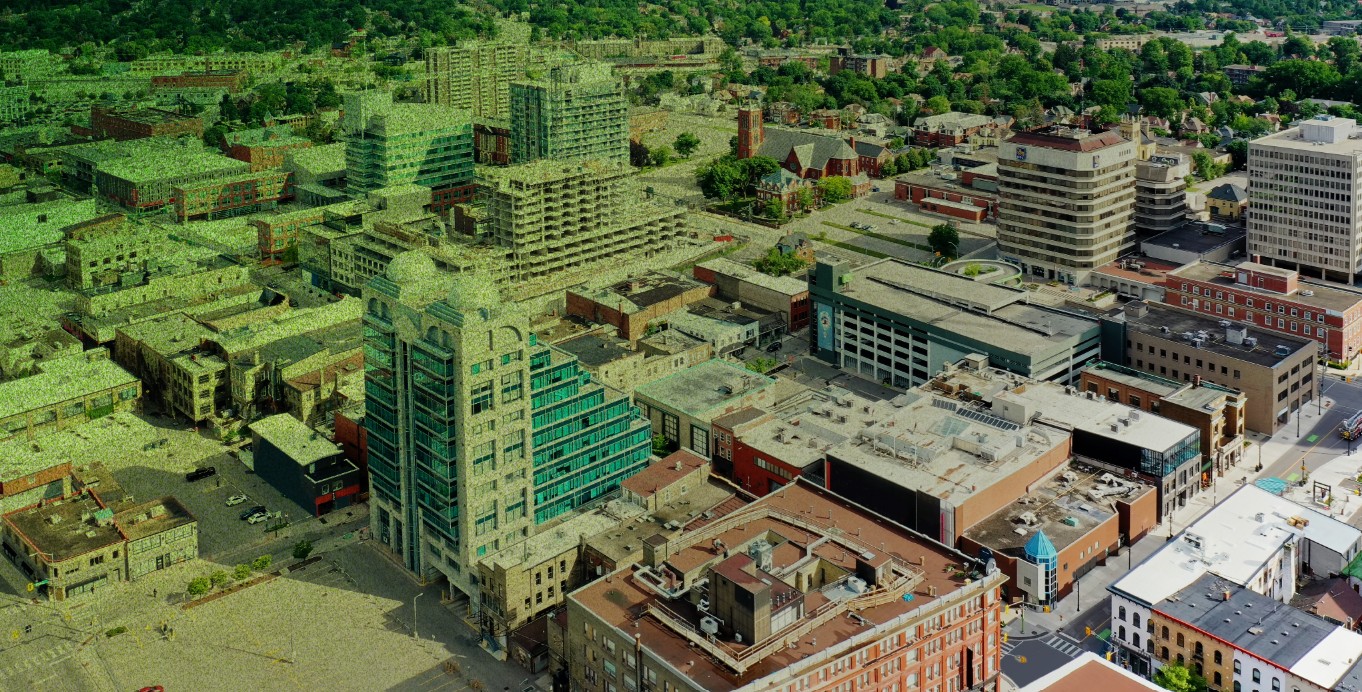
One of the most fascinating aspects of historic survey plans is their ability to capture communities at very specific moments in time, often just before everything is about to change.
In this article, we are stepping away from our traditional focus on the City of Toronto to examine a survey in another Ontario community: Kitchener.
This survey titled Amended Map of George J. Grimes Survey, Berlin C. W. This surveying, covering the area of Berlin, Canada West, is the community we know today as Kitchener.
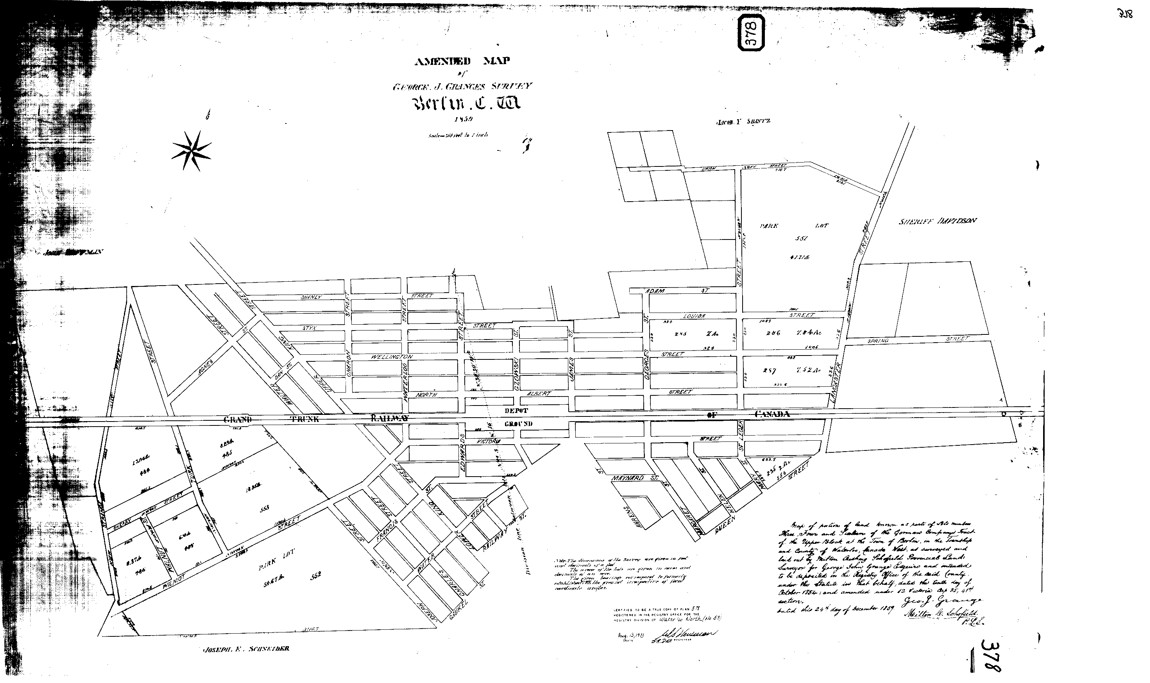
As I spent time examining the plan, several familiar street names began to emerge from the faded lines on the page. Queen Street, Lancaster Street, Wellington Street, Waterloo Street, Victoria Street, and Water Street all appear on the survey. More than 160 years later, many of those same streets continue to form part of Kitchener's downtown core.
The community remained known as Berlin until 1916. During the First World War, anti-German sentiment grew across Canada, and Berlin residents ultimately voted to change the town's name. On September 1, 1916, Berlin officially became Kitchener.
Not only does this survey preserve an early version of the city, it also preserves a name that disappeared from Ontario maps more than a century ago.
As I continued examining the plan, two features stood out more than anything else. One pointed toward Berlin's future. The other pointed toward its earliest beginnings.
The first was the Grand Trunk Railway cutting directly through the centre of the survey. The second was a reference buried within the handwritten certification that appeared to mention the German Company Tract.
Together, they tell a story about the evolution of the community.
The Grand Trunk Railway Arrives in Berlin
The most prominent feature on the survey is the Grand Trunk Railway.
Running through the centre of the plan, the railway immediately draws your attention. Near the tracks is a parcel identified as "Depot Ground," a detail that would have carried enormous significance when the survey was prepared.
Today, railways are simply part of the landscape. In the 1850s, however, they were transforming communities across the Province of Canada.
The Grand Trunk Railway was incorporated in 1852 and quickly became one of the largest railway systems in North America. Communities connected to the railway suddenly gained access to larger markets, faster transportation, and new economic opportunities. Industries could ship goods farther and more efficiently than ever before, helping many communities grow into important commercial and manufacturing centres.
The Depot Ground shown on the survey would likely have served as the operational heart of this railway corridor, accommodating station facilities, freight handling, and other railway functions.
Based on its location, the Depot Ground appears to have been situated in the vicinity of today's Kitchener GO Station. More than 160 years after the survey was prepared, the same area continues to serve as an important transport hub for the city.
The locomotives may be different. The station buildings may have changed. Passengers now travel much farther than they did in the nineteenth century. Yet the purpose remains remarkably similar.
Historic surveys do more than show how places have changed. They also reveal what has endured.
A Reference to the German Company Tract
While examining the handwritten certification in the lower corner of the survey, another detail caught my attention.
Buried within the text appears to be a reference to the German Company Tract.
Unlike the railway, which represents the future of Berlin, this clue points to the region's roots.
The German Company Tract traces its origins to the early nineteenth century when Mennonite settlers acquired large portions of land in what would become Waterloo County. The tract played a significant role in the settlement and development of the region and laid the foundation for many of the communities that followed.
What makes this reference particularly interesting is how it connects several different periods of local history.
The German Company Tract represents the earliest stage of settlement. The surveyed streets and town lots represent the growth of Berlin into a developing nineteenth-century community. The railway running through the centre of the map represents the arrival of a transportation network that would help shape the community for generations.
Remarkably, all three stories are preserved on the same sheet of paper.
Reading the Layers Beneath the City
When you look at a survey, it appears to be little more than a collection of streets, property boundaries, and lot dimensions. A closer look reveals evidence of early settlement, urban growth, transportation history, and even a community that would eventually change its name.
Even the title itself preserves a name that no longer exists.
Today, commuters board GO trains near the same location where the survey identifies the Depot Ground. Cars travel along streets that were already taking shape when this plan was prepared. Beneath the modern city is a landscape whose foundations can still be traced through documents like this one.
Historic survey plans provide far more than property boundaries and lot dimensions. They preserve moments in time and record layers of history that might otherwise be forgotten.
More than 160 years after it was prepared, this survey remains much more than a record of land ownership. It captures the layers of history beneath modern Kitchener: the lands of the German Company Tract, the growing town of Berlin, and the arrival of a railway that helped shape the community's future.
The streets, transportation corridors, and settlement patterns recorded on the plan continue to influence the city today. Beneath the modern landscape lies a history that can still be traced through documents such as this one, preserving a moment when Berlin was growing, changing, and unknowingly moving toward the city Kitchener would become.
References
Kitchener Public Library. “Kitchener Trivia.” https://www.kpl.org/services/local-history-and-genealogy/kitchener-trivia
Toronto Railway Historical Association. “Grand Trunk Railway.” https://www.trha.ca/history/railways/grand-trunk-railway/
The Canadian Encyclopedia. “Grand Trunk Railway of Canada.” https://www.thecanadianencyclopedia.ca/en/article/grand-trunk-railway-of-canada
Survey Images sourced from Protect Your Boundaries Archive. Protect Your Boundaries, www.protectyourboundaries.ca.









Protect Your Boundaries Inc. is a licensed member of the Association of Ontario Land Surveyors, and is entitled to provide cadastral surveying services to the public of the Province of Ontario in accordance with the provisions of the Surveyors Act R.S.O. 1990, Chapter S29.