
Before the Neighbourhoods: The Transformation of Davenport Hill

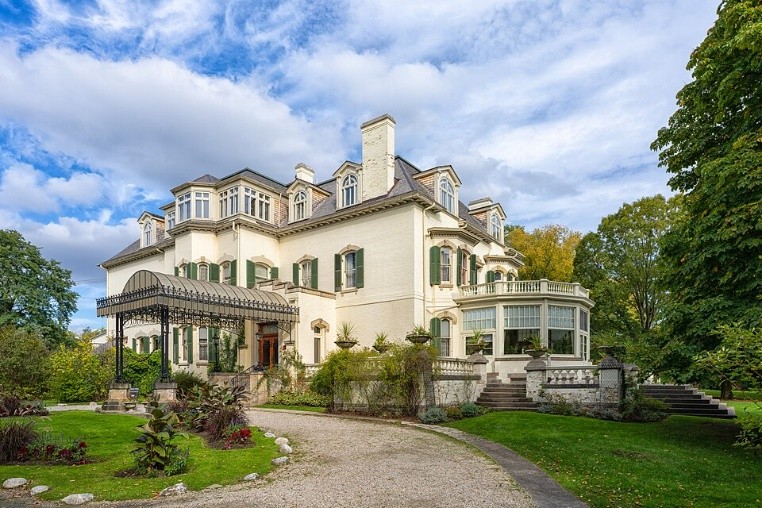
It all started on a hill above the city. Today the most recognizable structure in the area is Casa Loma, and the surrounding neighbourhood is filled with quiet residential streets, parks, and historic homes. Yet in the late nineteenth century this landscape looked very different.

The ridge north of Davenport Road, often referred to as Davenport Hill, was once dominated by large private estates owned by some of Toronto's most prominent families. Among them was the estate surrounding Spadina House, built in 1866 for Toronto banker James Austin. The estate, originally purchased from William Warren Baldwin in 1866, spanned roughly eighty acres and occupied a large portion of the ridge overlooking the rapidly growing city to the south. The Baldwin family had owned large plots of land along Davenport Hill for decades, helping shape the early development of the area long before the neighbourhood streets we recognize today came to be.
At the time this area was far removed from the busy streets of downtown Toronto. It was a desirable location for the wealthy, offering fresh air, open spaces, and impressive views of the city while still being close enough to the city.
Notable Estates
While the Austin estate dominated much of the ridge, it was not the only prominent property on Davenport Hill. Another notable figure to the east included the estate of Samuel Nordheimer, a prominent nineteenth century businessman and music promoter in Toronto. For many years these influential families occupied the ridge north of the city. Their expansive estates overlooking Toronto were largely undisturbed as the urban core continued to grow below.
1889: Mapping the Future Landscape
Historic survey plans such as the one shown here reveal how the landscape began to change as Toronto expanded north.
In 1889 James Austin sold and subdivided a significant portion of his estate lands. A survey plan prepared by Survey firm Unwin, Foote & Thorneloe and bore the witness signature of Austin that year shows how the property was divided into residential lots and laid out with streets that remain familiar today, including Austin Terrace, Spadina Road, and Davenport Road. The plan appears surprisingly modern, and the street grid closely resembles the neighbourhood that exists today.
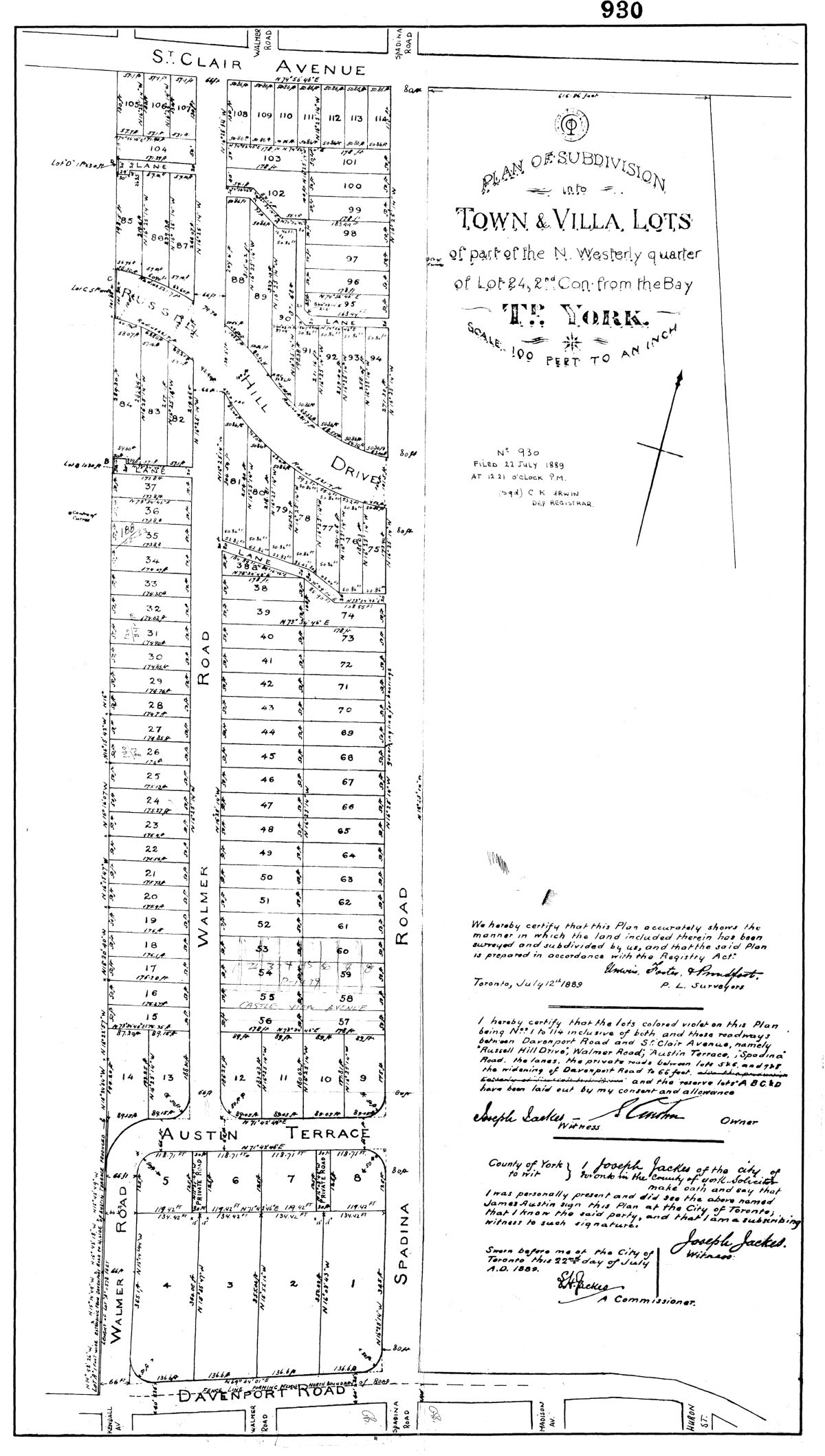
When examining the plan, it becomes clear that much of the land had not yet been built upon. Among the subdivided parcels are the very lots that would later become the site of Casa Loma, constructed between 1911 and 1914 for businessman Sir Henry Pellatt.
Land Is Divided and Sold
As Toronto continued to grow, the large estates on Davenport Hill were gradually subdivided and sold to make way for residential development and community resources.
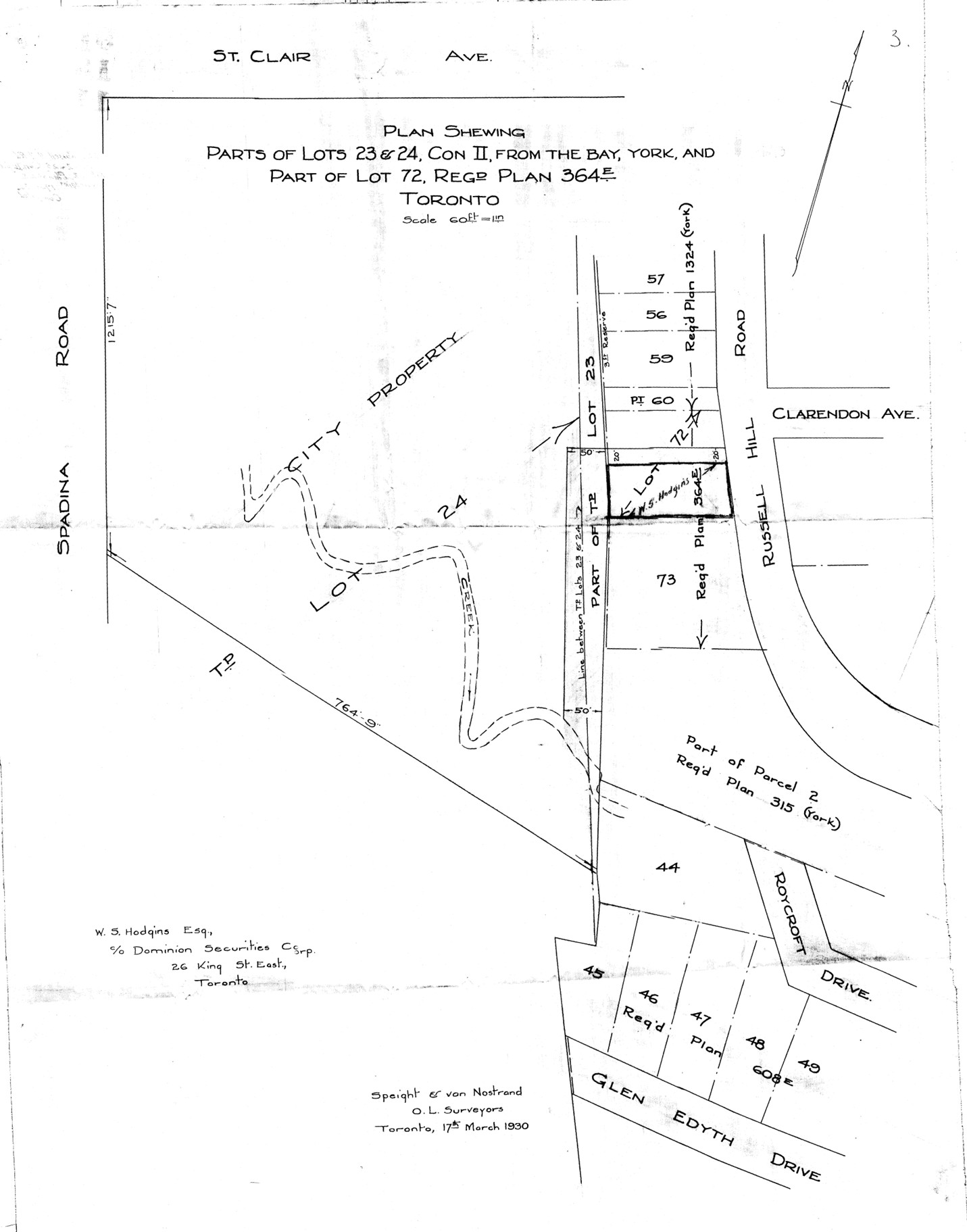
James Austin severed part of his land to give to family members and sold another piece to the Eaton family, where they later built the Ardwold Estate. Today the property to the east of Spadina House is a residential area along a street aptly named Ardwold Gate. A large portion of the lands belonging to both the Eaton and Austin estates to the north were later purchased by the City to construct the St. Clair Reservoir and Sir Winston Churchill Park.
From Estate Lands to Neighbourhood Streets
Today little remains of the vast estates that once dominated Davenport Hill. The ridge is now defined by residential streets, historic landmarks, and community parks, making it difficult to imagine the open grounds that once stretched across the hilltop. Yet historic survey plans preserve the story of how this landscape changed. They record when land was divided, who owned it, and how large estates were gradually transformed into neighbourhood streets and public spaces. While the grand homes of the Austins, Eaton’s, and Nordheimer’s once defined the ridge, the surveys they commissioned continue to tell the story of how Davenport Hill evolved into the community we recognize today.
References
1. “Baldwin, William Warren.” Dictionary of Canadian Biography,
https://www.biographi.ca/en/bio/baldwin_william_warren_7E.html.
2. “Casa Loma.” Encyclopaedia Britannica, Encyclopaedia Britannica, Inc.,
https://www.britannica.com/topic/Casa-Loma.
3. “Nordheimer, Samuel.” The Canadian Encyclopedia,
https://www.thecanadianencyclopedia.ca/en/article/samuel-nordheimer-emc.
4. “Pellatt, Henry Mill.” Dictionary of Canadian Biography,
https://www.biographi.ca/en/bio/pellatt_henry_mill_16E.html.
5. “Spadina House.” Wikipedia, Wikimedia Foundation,
https://en.wikipedia.org/wiki/Spadina_House.
6. “Spadina Museum.” City of Toronto,
https://www.toronto.ca/explore-enjoy/history-art-culture/museums/spadina-museum/
7. “Spadina House National Historic Site of Canada.” Parks Canada, https://www.pc.gc.ca/apps/dfhd/page_nhs_eng.aspx?id=15735.
Image & Survey reference:
Spadina House, Toronto. Wikimedia Commons, uploaded by P199,
https://upload.wikimedia.org/wikipedia/commons/4/49/Spadina_House%2C_Toronto.jpg. Accessed 11 Mar. 2026.
Survey Plans: Historic survey plans referenced in this article were sourced from the Protect Your Boundaries survey plan database.







Protect Your Boundaries Inc. is a licensed member of the Association of Ontario Land Surveyors, and is entitled to provide cadastral surveying services to the public of the Province of Ontario in accordance with the provisions of the Surveyors Act R.S.O. 1990, Chapter S29.